
Electrification is the next frontier in mining productivity
Diesel is one of the sector's largest and most volatile costs, with prices set by global markets that have no regard for Australian operations.

Sector opportunity: Australian miners are already making the switch
Mining helped build modern Australia. Our mines are among the best in the world, and they're just as essential to the economy we're building now, supplying the lithium in our batteries and the copper in our solar panels. Electric equipment, fleets and plant cut fuel costs, improve efficiency, and shield operations from price shocks no mine manager can control. Australian miners are already making the switch and are well placed to provide the technology and expertise that will help other industries follow, while setting the global benchmark.
32%
Around a third of Australian mining is already powered by electricity, and modelling shows that share more than doubling by 2035.
Volatility
Diesel is one of the sector's largest and most volatile costs, with prices set by global markets that have no regard for Australian operations.
What's possible
Modelling* shows Australia can power a greater share of mining with electricity.
Today
Electricity share of energy use
By 2035
Electricity share of energy use by 2035
Electrified mining in Australia
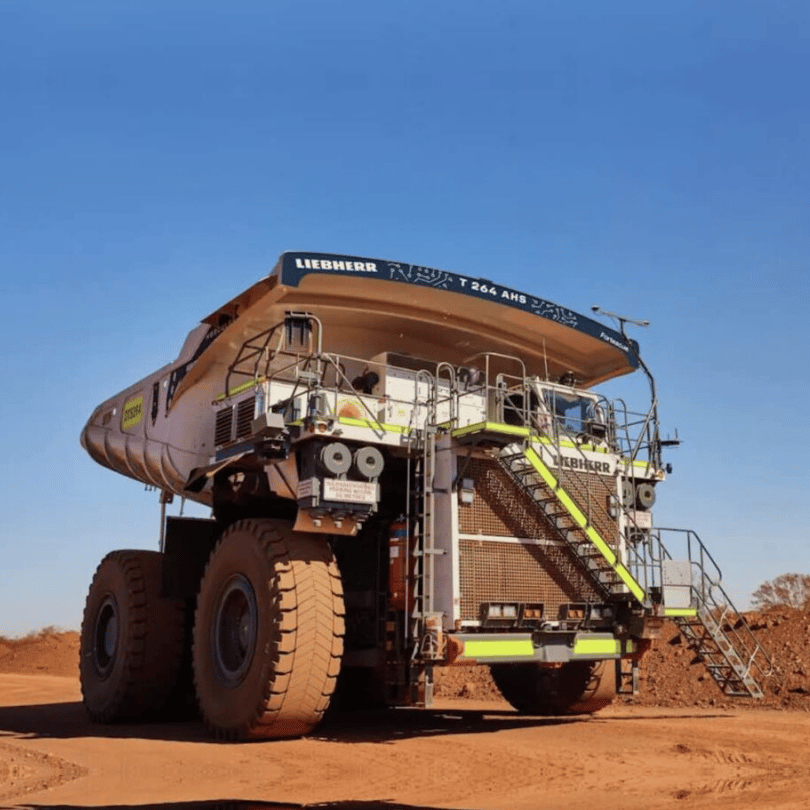
Fortescue and Liebherr recently teamed up to deploy Australia's first electric excavator.
At Fortescue's Solomon mine in the Pilbara, a fleet of around 180 pieces of equipment moves approximately 200 million tonnes of iron ore each year. To support its goal of fully decarbonising its operations by 2030, the company is transitioning its fleet to electric and battery-electric equipment. Working in partnership with Liebherr, Fortescue has deployed the first R 9400 E electric excavator operating in the Pilbara. Early results indicate the machine is matching the performance of its diesel counterparts, providing a practical pathway for reducing emissions from mining operations. The site team is also seeing operational benefits from electrification. While diesel excavators typically require refuelling every 24 hours, the electric excavator only needs to be stopped every 48 hours for routine performance and health checks. Operators have also reported fewer equipment failures, with the simpler design and lower number of moving parts helping to improve reliability and extend asset life. One of the most significant improvements has been in breakout force, with the electric excavator less prone to bogging down during operation than comparable diesel machines. Reduced strain on components is helping to extend their lifespan, while also delivering safety benefits by decreasing the frequency with which heavy parts need to be replaced. Case study credit: Liebherr
The policy ask
The Fuel Tax Credit should be reformed to incentivise electrification of mining equipment, while protecting the businesses that depend on it while viable solutions are still being developed: Cap the diesel fuel credit claims for large mining companies. A cap on mining companies only would mean farmers and small and medium enterprises are untouched and the change applies only to the heaviest industrial diesel users. Deploy part of the savings to accelerate decarbonisation and electrification. Reforming the application of the Fuel Tax Credit in the resources sector, with farmers and small businesses untouched, would level the playing field and let mining's electrification stack up on its own economics.
Cap the diesel fuel credit claims for large mining companies. A cap on mining companies only would mean farmers and small and medium enterprises are untouched and the change applies only to the heaviest industrial diesel users.
Deploy part of the savings to accelerate decarbonisation and electrification.

Reduce diesel dependence to build more productive, competitive and resilient Australian mines.
Cap the diesel Fuel Tax Credit regime to incentivise electrification of mining equipment.
A platform for change
The barriers differ by sector. The answer is the same everywhere — clear policy signals, effective regulation and targeted incentives that reach the people and businesses currently locked out of the switch.
Put around $2,000 a year in savings within every household’s reach.
An Electrified Households package — new targeted and conditional Commonwealth funding for states, territories and councils to electrify rental properties, social housing, and First Nations and low-income households currently locked out of the switch.
Give manufacturers energy costs they can count on.
An Electrified Industry program targeting key subsectors to move to heat pumps for low temperature process heat. Alongside it, legislate a demand-side compliance mechanism into the Domestic Gas Reservation Scheme.
Back the switch already underway on Australian farms.
An Electrified Farming program to give farmers choice to replace equipment that is well suited to electrification. Alongside it, remove the regulatory barriers to on-farm energy sharing that do not exist for liquid fuels.
Stop importing the fuel that moves everything we buy.
Two programs, equally weighted. An Electrified Freight program to cut upfront costs for small and medium businesses. And an Accessible EVs program for new and second-hand cars and charging infrastructure for low-income households.
Signal where the energy system is heading, then build for it.
Issue an Australia’s Electric Future vision statement setting out the central role of electrification in every sector. Alongside it, set up Connecting the Suburbs and Connecting the Regions programs.
Take the tax thumb off the diesel scale.
Cap the diesel Fuel Tax Credit regime to incentivise electrification of mining equipment, while protecting the businesses that depend on it. Farmers and small and medium enterprises stay untouched.
Buildings that cost less to run, for owners and tenants alike.
An Electrified Commercial Buildings program that strengthens finance and procurement settings. Alongside it, accelerate the expansion of the Commercial Building Disclosure program.
Electrify Australia is a growing movement of consumer, business, civil society and research groups advocating for a national effort to accelerate electrification, to secure an affordable and resilient energy future for everyone.
Electrification means swapping gas, diesel and petrol for electric alternatives powered by renewables, so households, businesses and industry run on cheaper energy that's made in Australia.
* Footnote on modelling:
Today” is 2023-24, the latest available data from the Australian Energy Update 2025. 2035 numbers are EEC analysis of a scenario based on Climateworks Centre Centre decarbonisation scenarios 2023: Paris Agreement alignment for Australia. This is consistent with sourcing around 35% of Australia's final demand from electricity in 2035.